
The end of an era and the Renaissance Developer.
Werner Vogels' last keynote marked one of highest moments of re:Invent 2025, left us with his legacy to carry on.

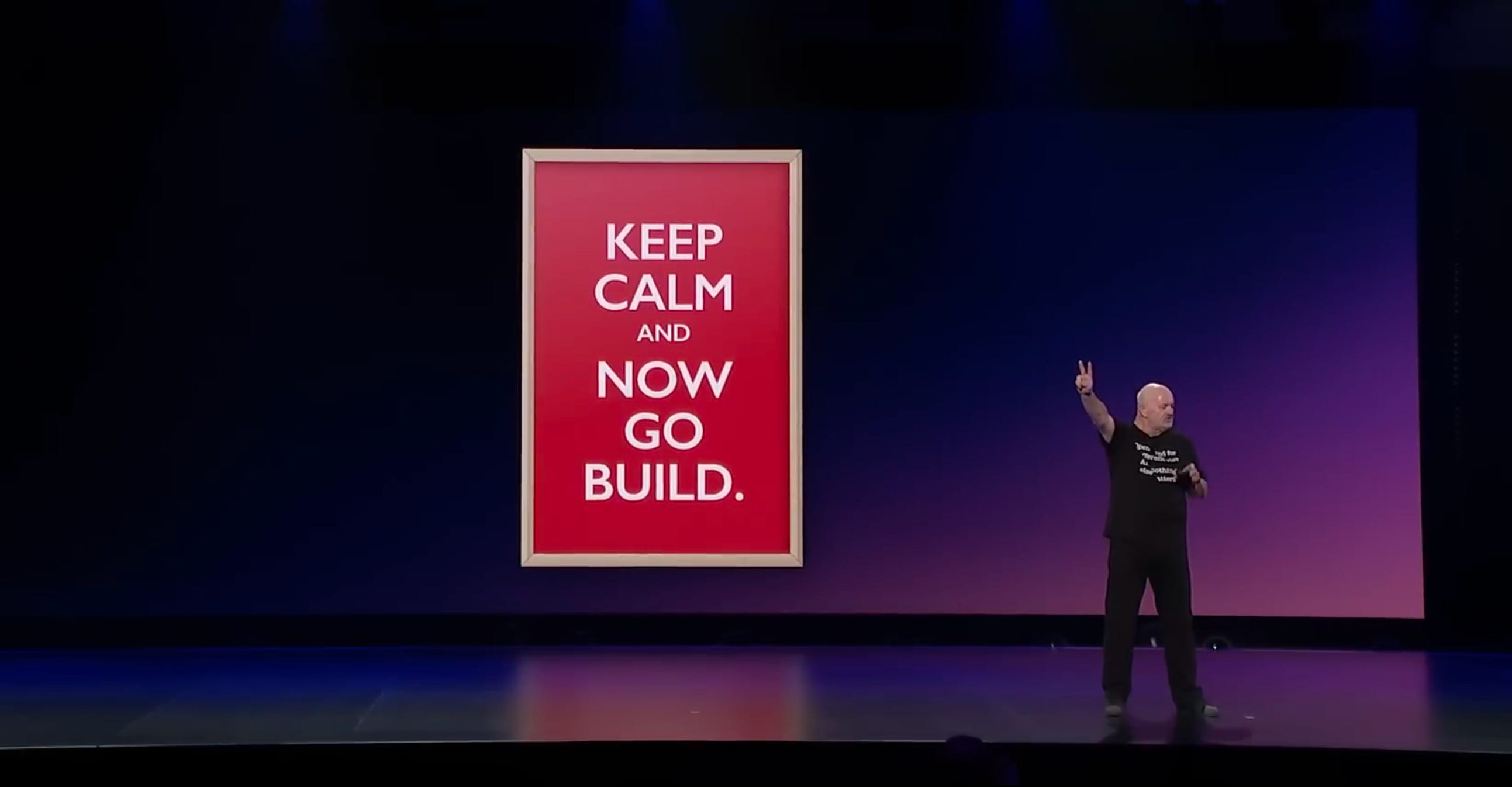
Two more words: “Werner’s out!”
When the mic drops on stage, we all know an era is over. Werner Vogels’ last keynote marked one of the most emotional moments of this 2025 re:Invent and ended the best of a 14-year keynote series. The bittersweet sensation that comes when you realize one of the pioneers of our modern age decides it’s time to step back and let younger forces tell stories about these transformative times is both hard to elaborate on and leaves you with a feeling of a full circle.
Seniority is not the ability to hold the microphone; it’s the courage to hand it to the next generation:
“There are so many amazing engineers at Amazon that have great stories to tell… It’s time for those younger, different voices of AWS to be in front of you.”
It came after a one-hour packed discussion about how to deal with these transformative times. Werner's last gift is a message of hope and a call to become better builders, better professionals, better humans. The theme of the entire keynote can be summarized in one line:
The tools will change; the work is still yours.
From that premise, Vogels unfolds a framework for the Renaissance Developer—a model not just for engineers but for any technical leader who wants to stay relevant and effective in an AI-accelerated world. To make his point, Vogels does what experienced engineers do when everyone is panicking about the future: he zooms out over decades. Every wave followed the same pattern: tools changed dramatically, the work changed shape, and the developer's identity stayed the same: we build systems that matter. This is the context in which he answers the AI anxiety. We’re not at the end of development; we’re in yet another phase of abstraction. The difference today is the density of change. As Jeff Bezos has put it, we’re living at the epicenter of multiple “golden ages”—space, robotics, and AI—whose breakthroughs amplify one another.
Werner’s conclusion: if you anchor your career in specific tools, you’ll be swept away. If you anchor it in enduring capabilities, you’ll ride the wave. Those capabilities are what he calls the Renaissance Developer's qualities, drawing on a period when tools and ideas reinforced one another, reshaping civilization: the Renaissance. Tools didn’t replace humans; they expanded the surface area of what humans could explore.
Curiosity
The very first quality of the Renaissance Developer is curiosity: in a world of AI‑accelerated change, it becomes a survival skill and a professional obligation. But curiosity requires experimentation and failure. If you are not allowed to fail, you can’t thrive. But it comes with pressure: too little leads to boredom and disengagement, while too much leads to overwhelm and paralysis. The Yerkes–Dodson law explains that the sweet spot is enough challenge to stretch you without breaking you.
This comes with connections: “Learning isn’t just cognitive, it is social.” You don’t become a Renaissance Developer by sitting alone with tutorials; you grow by seeking out communities, sitting in user groups and conferences where ideas collide, lingering over coffee with peers while you argue about systems, and deliberately placing yourself in new contexts and constraints so that real experiences, real people, and real problems can stretch your thinking far beyond what isolated study can do.
As a leader, your job is not to protect your team from failure; it is to make failure cheap and reversible, to put people in environments where they are exposed to new ideas and constraints, and to reward learning behavior as much as successful outcomes.
Systems Thinking
The second quality is systems thinking. Not “distributed systems” in the narrow sense, but systems in the broader sense that Donella Meadows wrote about.
“A system is a set of things—people, cells, or whatever—interconnected in such a way that they produce their own pattern of behavior over time.”
Meadows invites us to stop staring at individual events and instead notice the structures that generate them. She asks us to look for the “stocks and flows” beneath the surface: the queues that build up in a support channel, the backlog that silently grows as new features outrun maintenance, the slow accumulation of technical debt that barely shows up in daily metrics but eventually locks a team in place. These are the reservoirs of a system. They fill and drain at different speeds, and they determine the patterns we see in performance, morale, and reliability. Meadows points to feedback loops, circuits of cause and effect that either reinforce a trend or hold it in check. In a reinforcing loop, every success makes the next success easier, like a product that improves, gains users, and generates the data that makes it better still. In a balancing loop, the system pushes back, like a throttling mechanism that slows calls when the load becomes too high. Our organizations, our processes, and our code are full of these loops. Some stabilize; others amplify; many conflict with each other in ways that only become visible over time. Crucially, systems have delays and nonlinearities. Actions and consequences are often separated in time and space: you approve a shortcut in architecture, and only months later, the on‑call rotation begins to burn out. You improve incident response without touching the upstream causes and find that you are getting better and better at cleaning up the same problems. Because of these delays, intuitive fixes—more meetings, more reviews, more dashboards—can easily make behavior worse if they are placed in the wrong part of the system. This is why Meadows focuses on leverage points: small, carefully chosen interventions that produce outsized effects. You can change parameters—such as timeouts, thresholds, or team size—and achieve incremental improvement. You can change information flows—who sees which metrics, which stories reach leadership—and unlock better decisions. You can change rules and incentives—what gets rewarded in performance reviews or funded in roadmaps—and watch priorities shift without a single line of code. At the deepest level, you can change goals and mental models—what “good” looks like for reliability, cost, or user experience—and the entire architecture starts to evolve in a new direction. If you keep treating problems as isolated bugs or incidents, you will keep fighting the same fires. Once you see your work as part of a living system of stocks, flows, feedback loops, delays, and leverage points, you stop searching for silver bullets and start looking for thoughtful, well‑placed changes that reshape behavior over time.
Communication
Natural language is powerful but ambiguous. Programming languages forced us to be precise because they refused the shortcuts and half-thoughts that humans understand from context. With AI-assisted coding, we are back to prompting in natural language, and vague prompts don’t just slow us down; they create misalignment—code that looks sophisticated but solves the wrong problem, hallucinated fields and APIs, and designs that quietly undermine the architecture they were meant to serve. Craft clear specifications as the bridge between human intent and machine-generated implementation. A good spec compresses ambiguity into clarity, forces us to decide what success looks like, which constraints we accept, and which trade-offs we will make, and becomes the shared reference point where product, engineering, and AI tools can actually align. Learn to ask “why” before “how.” When a customer asks, “What should we be doing with GenAI?”, the first move is not to list features but to ask, “Why are you asking? What problem or opportunity do you see?” From that deeper conversation comes sharper intent, a better specification, and a system that actually matters. For leaders, this is why communication is a core technical skill: diagrams, narratives, and specs are the instruments through which you shape the system, and in an AI-heavy workflow, the quality of your words still determines the quality of your systems.
Ownership
AI does not dilute accountability. “The work is yours, not the tools.” If you operate in regulated environments—healthcare, finance, critical infrastructure—and AI generates code that violates regulation, you cannot tell a regulator, “The AI did it.” Responsibility does not move with the autocomplete cursor. AI mainly amplifies two dangers: it can create verification debt, where code is generated faster than you can truly understand it, and it can hallucinate confident but wrong output—non-existent APIs, architectures that violate your own patterns, designs that look elegant but are not grounded in reality.
For leaders, ownership in the age of AI means accepting that models will write much of the code while you design and protect the mechanisms that keep it safe: clear specifications, honest reviews, explicit stop buttons when something feels wrong. Renaissance Developers don’t just own their code; they own the feedback loops and safeguards that keep quality high even as the tools get faster.
Be a polymath
Vogels is clear that this isn’t about mathematics; the word comes from the Greek for “to learn many things.” A polymath goes deep in at least one domain and yet refuses to stay narrow, cultivating meaningful knowledge across others. Leonardo da Vinci is the visible archetype—painter, engineer, anatomist, inventor—but Vogels’ fundamental point is that modern developers cannot afford to be merely I‑shaped specialists.
Instead, he urges us toward a T‑shaped posture: depth like a spine, breadth like outstretched arms. His mentor Jim Gray embodied this. Gray could listen to a server room for half a minute and diagnose a broken database layout, not only because he understood databases intimately but also because he understood the data, the scientists, and how the organization worked. That combination of technical depth, domain insight, and human awareness is what makes expertise decisive rather than decorative.
For leaders, the lesson is demanding and straightforward: grow people who can dive deep and still speak the neighboring languages around them. When a backend engineer understands cost and product, their designs change. When a data engineer understands the story the numbers must tell, their questions sharpen. When a platform engineer understands developer experience, their tools become catalysts rather than constraints. Breadth is not a distraction from depth; it is the amplifier that lets depth shape the whole system.
Werner’s legacy
When looking at the empty stage, the previous keynote pictures rolling, I started reflecting on Werner’s legacy: it is a way of inhabiting the craft. Protect and fuel curiosity so that learning never stops. Think in systems so that every change you make respects the invisible structures it touches. Raise the bar on communication so intent, design, and implementation move in sync. Build real mechanisms, not just good intentions, especially when AI accelerates your work beyond your first understanding. And grow T‑shaped people whose depth is amplified, not constrained, by their breadth.
The tools will keep changing. They always have. What endures is the standard he set: use the most powerful tools in history in service of the biggest problems of our time, quietly, rigorously, and with pride in the work that no one sees.